Leadership · Discipline · Peace of Mind
The Control Filter
A framework for the days when business, people, and life all decide to go sideways at once.
Most stress in business does not come from the problem in front of you. It comes from the part of the problem that was never yours to begin with, and from the hours you spend wrestling it anyway.
Markets change. People disappoint you. Customers say no. The economy shifts, competitors copy your best idea, and somebody leaves a one-star review because it rained on the day of their appointment. None of that is yours. You will not vote it away, post it away, or worry it away.
What you own is the response. That sounds like a poster in a break room until you build a system around it, and then it starts paying you back. This is the system I use. It takes about four minutes on a normal morning and about ten on a bad one.
Every morning, before I look at sales, competition, politics, or my phone, I ask one question: what can I control today?
Step OneRun It Through the Filter
When something lands on you, and something always lands on you, do not react to it yet. Run it through four questions first. Do this on paper or out loud in the truck, but do it before you make a single phone call.
- Is any part of this mine? Split the problem in half. There is the part you own and the part you do not. Most people work the wrong half for a week before they notice.
- What is the one move I can make today? Not the plan, not the strategy, the one action you can finish before you go to bed tonight.
- What am I releasing? Say the rest out loud and let it go. It still exists, it is still ugly, and it is no longer taking rent from your head.
- Who does this affect besides me? Your reaction sets the temperature for your whole team. They are watching you decide whether today is a crisis.
That fourth question is the one people skip, and it is the one that makes this leadership instead of self-help. Your crew reads your face before they read your email. Panic is contagious and so is composure.
Step TwoWork the Four Lanes You Own
Everything inside your control lives in one of four lanes. When you feel scattered, it is usually because one lane has gone quiet while you were busy fighting something that was never yours. Find the quiet lane and go work in it.
Mindset
The lane that decides how heavy everything else feels
- Your attitude. Every morning you choose between attacking the day and complaining about it, and the choice gets made whether you make it on purpose or not.
- Your perspective. The same problem is a disaster or a door depending on where you stand when you look at it.
- Your thoughts. Your mind becomes whatever you feed it, so watch the diet.
- Your reactions. Life is ten percent what happens and ninety percent what you do in the next sixty seconds.
- Your response to failure. Failure is information about a decision. It is not a verdict on you.
- Your response to success. Stay humble, stay hungry, and remember that the market has humbled better operators than both of us.
- Your gratitude. It is difficult to feel defeated while you are busy being thankful, and I have tested this one in some bad years.
Effort
The lane nobody can enter but you
- Your effort. Talent helps and effort decides. One is issued to you, the other is chosen every morning.
- Your preparation. Luck favors the prepared, which is a polite way of saying luck skips the lazy.
- Your work ethic. Nobody outworks the person who refuses to quit, which is the only advantage available to everyone.
- Your habits. Your future is built out of whatever you repeat, so audit the repeats.
- Your discipline. Motivation shows up for the fun part and leaves before cleanup. Discipline stays through the whole shift.
- Your consistency. Small actions repeated for years will bury occasional bursts of enthusiasm every single time.
- Your courage. Growth lives on the other side of a conversation you do not want to have.
Energy
The lane that funds the other three
- Your health. Sleep, food, movement. Nobody can do these for you, and the bill comes due on schedule.
- Your time. It is the one investment you cannot add to, so spend it like the limited account it is.
- Your priorities. When everything is important, nothing is, and your team can tell which one you meant.
- Your energy. Protect it from negativity and from people who treat you like a utility.
- Your relationships. Choose people who make you better and be honest about who does the opposite.
- Your willingness to learn. The day you stop learning is the day somebody younger starts closing the gap.
- Your willingness to ask for help. Every operator I respect has mentors, and every one who flamed out thought asking was weakness.
Character
The lane that outlives the business
- Your honesty. Integrity compounds, and so does the other thing.
- Your words. Words build businesses, relationships, and reputations, and they take them apart just as fast.
- Your kindness. Strong people have no need to be cruel. Cruelty is what people reach for when they have run out of strength.
- Your character. Nobody will remember every sale you made. They will remember exactly who you were on the day it got hard.
Step ThreeName the Noise and Leave It There
Here is the part that buys back your peace. Write the list of what you do not control, keep it somewhere you can see it, and when one of those items shows up in your head at two in the morning, name it and put it back on the list. Naming it is what breaks the loop.
The Noise List
- The economy
- Politics
- Other people’s opinions
- Competitors
- Social media comments
- Traffic
- The weather
- Past mistakes
- Other people’s effort
- Unexpected setbacks
Accept them. Prepare for them. Move forward anyway. That is the whole policy, and there is no version of it where you get to argue with the rain.
Step FourRun the Daily Reset
A framework you use once is a nice idea. A framework you run every day becomes the way you think, and eventually you stop needing the paper. Here is the reset, morning and night.
Morning, three minutes
Name the one thing that is bothering you. Split it into the part you own and the part you do not. Pick a single action from one of the four lanes and put it on the calendar before anything else claims the hour.
Evening, two minutes
Ask what you controlled well today and what you gave away for free. Then ask which lane went quiet, because that is tomorrow’s work. This takes less time than scrolling your phone in the driveway, and it pays considerably better.
Step FiveThe Ten-Minute Version for Bad Days
Some days the whole thing comes apart before nine in the morning. A tech quits, a job goes wrong, a big customer walks. On those days the framework shrinks down to one instruction: pick the smallest thing you can finish, finish it, and let finishing it prove to you that you still have hands on the wheel. Momentum is built out of completed small things, not solved big ones.
Then go find your people. Tell them the truth about what happened, tell them which part is ours to fix, and give them one move each. A team that knows its lane does not panic, because panic is what fills the space where instructions should have been.
The CloseStraight Talk
After 36 years in this business, I have watched a lot of people win and a lot of people fold, and I can tell you the winners were rarely the smartest, the richest, or the most talented in the room. They were the ones who kept showing up, worked the part that belonged to them, and refused to bleed energy on everything else.
You do not have to win the whole week today. You only have to win today, and today starts by controlling the things that are yours to control.
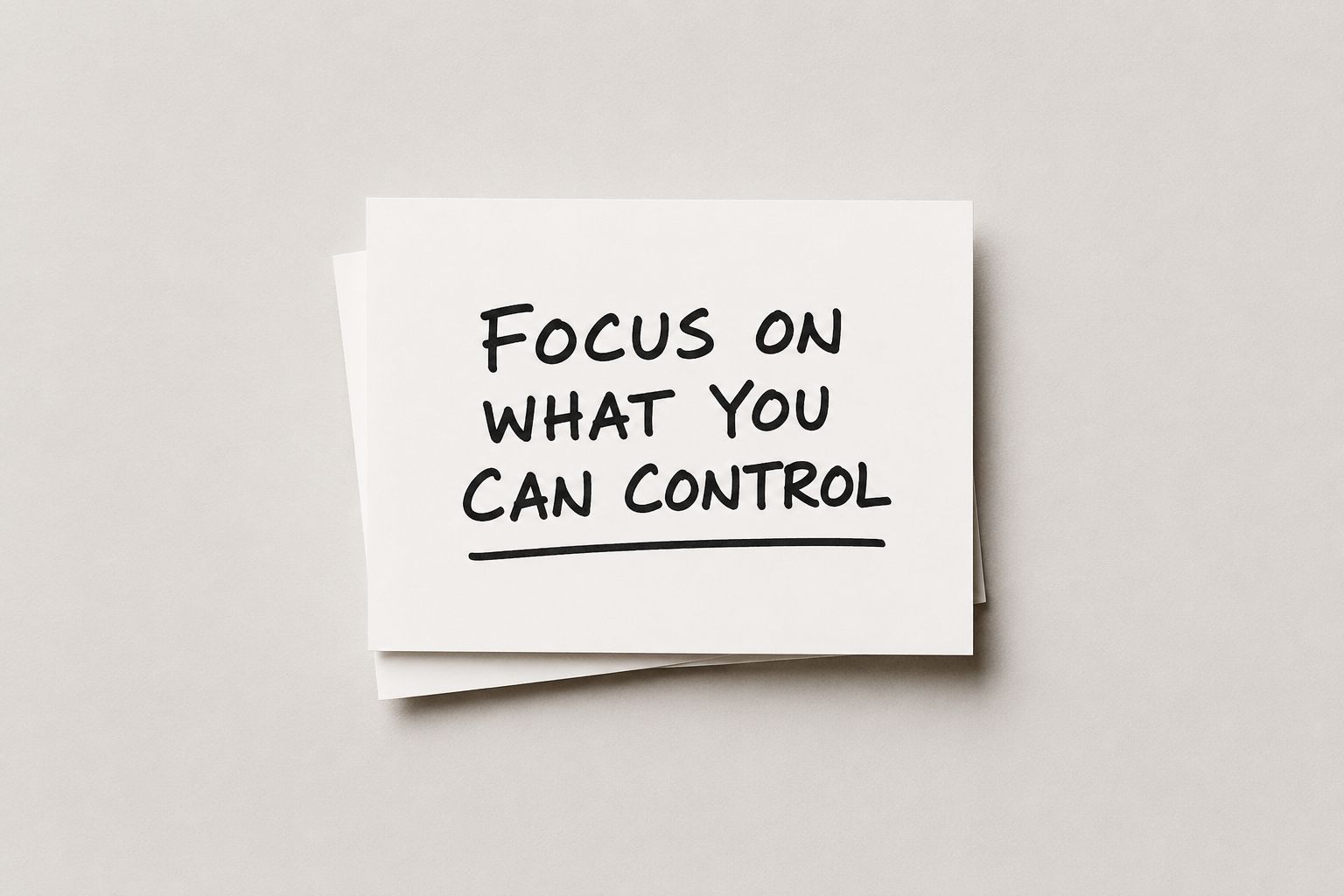
Focus there. Everything else is noise, and noise has never once paid an invoice.
Mike Burke
Founder, Sun Stoppers | Entrepreneur · Speaker · Coach